
Non-verbal reasoning (NVR) is often the subject that surprises parents the most. Unlike maths or English, there are no textbooks on it at school. Yet it appears in virtually every 11+ exam—and the good news is that it's highly trainable with the right approach.
What Is Non-Verbal Reasoning?
Non-verbal reasoning tests your child's ability to identify patterns, relationships, and rules in visual information—without relying on words or numbers. It measures logical thinking and spatial awareness through shapes, sequences, and diagrams.
Think of it as visual problem-solving: spotting what's changing, what stays the same, and predicting what comes next.
Why NVR Matters for the 11+
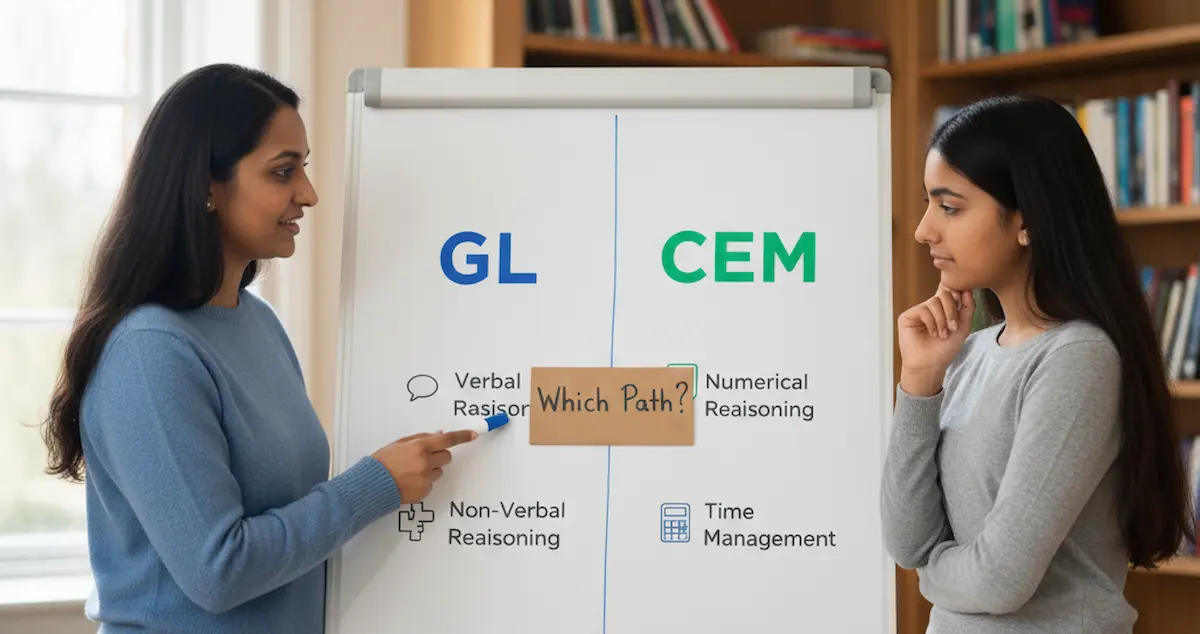
- It appears in both GL and CEM exams (though the weighting differs).
- It's the most "learnable" subject—children who practise NVR regularly see significant score improvements.
- It levels the playing field—NVR is less dependent on prior academic attainment than maths or English.
- It develops transferable skills—pattern recognition helps in maths, science, and technology.
The Main NVR Question Types
1. Find the Odd One Out
Four or five shapes are shown; one doesn't follow the same rule as the others. Your child must identify what makes most shapes similar, then find the exception.
Strategy: Systematically check: shape, size, shading, rotation, number of sides, symmetry.
2. Complete the Series
A sequence of shapes follows a pattern. The child must identify the rule and choose what comes next.
Strategy: Look for: rotation (clockwise/anticlockwise), size changes (growing/shrinking), shading patterns (alternating), element addition/removal.
3. Analogies (A is to B as C is to ?)
Two shapes have a specific relationship. The child must apply the same relationship to a third shape to find the answer.
Strategy: Describe the change from A to B in words, then apply the same change to C (e.g., "rotated 90° clockwise and shading inverted").
4. Codes
Shapes are assigned letter or number codes based on their properties. The child must crack the code and apply it to a new shape.
Strategy: Build a systematic key: one code for shape, one for shading, one for size, etc.
5. Spatial Reasoning (Nets, Reflections, Rotations)
These test the ability to mentally manipulate shapes: folding 2D nets into 3D shapes, reflecting across lines, or rotating figures.
Strategy: Practice with physical paper folding first. Cut out shapes, fold them, and see the results before moving to paper-based exercises.
6. Matrices
A 3×3 grid with one missing square. Patterns run across rows, down columns, or both. The child must identify the missing piece.
Strategy: Check rows first, then columns. Look for: repeating elements, progressive changes, and combinations.
How to Practice NVR Effectively
Start with Understanding, Not Speed
Unlike maths where the method is taught in school, NVR needs explicit instruction in how to look at problems. Spend the first few sessions working through examples together, verbalising what you both see.
Build a Systematic Checklist
Teach your child to check each shape property systematically:
- Shape type: Circle, square, triangle, pentagon, etc.
- Size: Large, medium, small—or changing?
- Shading: Black, white, striped, dotted?
- Orientation: Rotated? Reflected?
- Number: How many elements? Increasing or decreasing?
- Position: Top, bottom, inside, outside?
Progress from Untimed to Timed
Start with no time pressure to build understanding. Once your child is getting 70%+ correct untimed, introduce gentle time constraints. For timed practice, aim for about 30 seconds per question.
Use Error Analysis
When your child gets a question wrong, don't just show the answer. Ask: "What did you look at?" and "What did you miss?" This builds self-awareness of blind spots.
Common NVR Mistakes and How to Fix Them
| Mistake | Cause | Fix |
|---|---|---|
| Picking first plausible answer | Rushing or overconfidence | Check ALL options before answering |
| Missing rotation patterns | Not tracking direction | Use a finger to trace rotation |
| Confusing reflection and rotation | Spatial awareness gap | Practice with a mirror and physical shapes |
| Overlooking multiple rules | Focusing on one property only | Use the systematic checklist above |
NVR Practice Schedule
For best results, include NVR 2–3 times per week alongside your other 11+ subjects:
- Monday: 10–15 mins focused NVR (one question type at a time)
- Wednesday: 10 mins mixed NVR practice
- Friday: Review errors from the week + 5 min speed drill
Quick FAQ
Q: My child finds NVR really hard—is this normal?
A: Yes! NVR isn't taught in primary school, so most children start from scratch. With consistent practice, improvement is usually rapid.
Q: Are NVR and spatial reasoning the same thing?
A: Spatial reasoning is a subset of NVR. NVR includes pattern recognition, sequences, and codes alongside spatial skills.
Q: How much NVR practice is enough?
A: 2–3 short sessions per week is ideal. Consistency matters more than duration.
Master the other half of reasoning → All 21 Verbal Reasoning Question Types
Plan your overall preparation → The Ultimate 11+ Preparation Timeline
Use our practice resources for NVR question sets.