
Planning for the 11+ in 2026? Whether you're just starting your research or already deep in preparation, this comprehensive guide covers everything you need to know about the 11+ exam this year—from key dates and regional differences to proven preparation strategies.
What's New for 11+ in 2026?
The 11+ landscape continues to evolve. Here are the notable changes and trends for the 2026 exam season:
- Digital testing pilots: A small number of regions are expanding digital test delivery, though paper-based remains the standard for most areas.
- Increased demand: Grammar school places remain highly competitive, with application numbers continuing to rise in many regions.
- Hybrid approaches: Some schools are adopting mixed formats that blend GL-style structure with CEM-style vocabulary demands.
- Accessibility improvements: More provisions for special educational needs, including extra time and modified papers.
Key Dates for 11+ 2026
While exact dates vary by region and exam board, here's a typical timeline:
| Period | Activity | Notes |
|---|---|---|
| January–March 2026 | Registration opens (many regions) | Check your local consortium's website |
| May–June 2026 | Registration deadlines | Don't miss these—late applications may not be accepted |
| September 2026 | Main exam dates | Typically early–mid September for most regions |
| October 2026 | Results released | Usually 4–6 weeks after the exam |
| October 31, 2026 | Secondary school application deadline | National deadline for state school applications |
| March 2027 | National Offer Day | When school places are formally offered |
Regional Exam Formats
The 11+ isn't one single exam—it varies significantly by region. Here's what the major areas use:
GL Assessment Regions
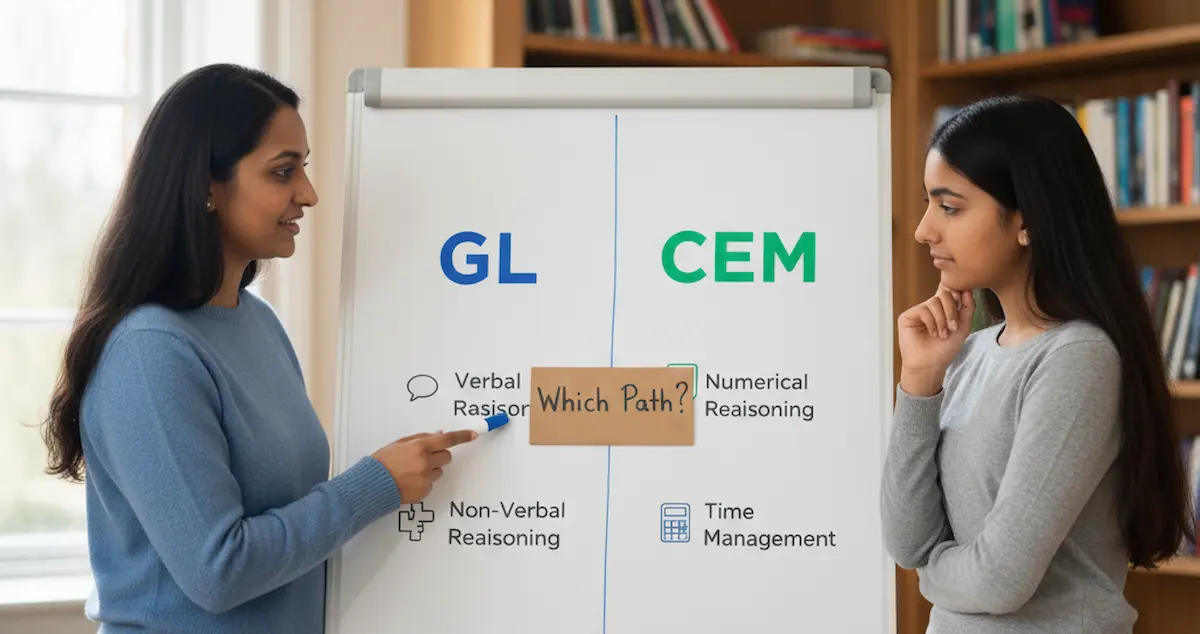
Most grammar school regions use GL Assessment papers: Buckinghamshire, Essex (CSSE), Kent (some schools), Lincolnshire, Warwickshire, and others. GL tests separate subject papers with predictable question types.
CEM Regions
Durham/CEM-style tests are used in: Birmingham, Gloucestershire, parts of Kent, South West, and others. CEM tests blend sections and are less predictable, with a strong vocabulary focus.
Independent School Exams
Many independent schools set their own exams or use ISEB Common Pre-Tests. These often include creative writing and interview components alongside academic papers.
How to Start Preparing Now
If you're reading this in early 2026 and your child will sit the exam in September, here's a practical starting plan:
Step 1: Know Your Test
Confirm exactly which exam board and format your target schools use. Check school websites, contact admissions, or browse our school directory for details.
Step 2: Get a Baseline
Run a diagnostic assessment to understand your child's current strengths and gaps. Focus preparation on genuine weaknesses rather than practising what they already know.
Step 3: Build a Weekly Schedule
Aim for 3–4 short sessions per week (20–30 minutes each). Cover maths, English, verbal reasoning, and non-verbal reasoning across the week. See our detailed preparation timeline for month-by-month guidance.
Step 4: Focus on Vocabulary
Vocabulary is consistently the highest-yield investment for both GL and CEM exams. Start with our 30-day vocabulary system.
Step 5: Practice Under Timed Conditions
Gradually introduce timed practice from the Year 5 summer term. Begin with generous time limits and tighten as confidence grows.
Common Mistakes to Avoid
- Starting too early with papers: Formal past papers before Easter of Year 5 often leads to burnout.
- Ignoring non-verbal reasoning: NVR is highly learnable and can significantly boost overall scores.
- Cramming in the final weeks: The last 2–3 weeks should focus on consolidation and wellbeing, not new material.
- Comparing with other families: Every child's journey is different; what works for others may not suit yours.
What Score Does Your Child Need?
This varies enormously by region and school. Most grammar schools look for scores in the top 15–25% of applicants, but actual cut-off scores change each year based on the cohort. See our detailed guide on how 11+ scoring works.
Quick FAQ
Q: Is it too late to start preparing in spring of Year 5?
A: Absolutely not. Many children achieve excellent results with focused preparation starting in spring or even summer of Year 5.
Q: Do I need a tutor?
A: Not necessarily. Many families successfully prepare using structured resources and adaptive platforms. However, a tutor can help if your child needs personalised guidance.
Q: What if my child doesn't pass?
A: The 11+ is just one pathway. Many excellent secondary schools don't use selective entry, and your child's abilities extend far beyond a single exam.
New to the 11+? Start with our comprehensive overview → What the 11+ Entrance Exam Really Is
Understand the different exam formats → GL vs CEM: Which Exam Style?
Browse our interactive preparation timeline to plan your family's journey.